

NewsDetails
CNC Machining Parts: Precision Manufacturing for Industrial Applications
author:Kiyama time:2026-05-23 17:42:23 Click:152
Understanding Modern CNC Machining Capabilities
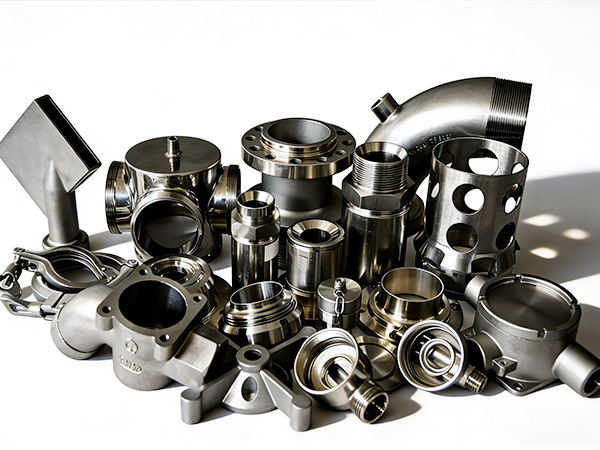
Walk into any modern machine shop today, and you'll witness something remarkable—computer-controlled tools removing material with tolerances measured in thousandths of an inch, repeatedly, hour after hour. That's the reality of CNC (Computer Numerical Control) machining, and it has fundamentally transformed how precision parts get manufactured.
.jpg)
.jpg)
The technology isn't new, but it keeps getting better. Modern CNC machines can hold tolerances that would have seemed impossible twenty years ago. They can run unattended for hours. They can switch between multiple tools automatically. And perhaps most importantly for businesses like Kiyama Precision Manufacturing, they can produce complex parts consistently, whether you need ten pieces or ten thousand.
When you're supplying critical components to industries where failure isn't an option—think petrochemical processing, food and beverage, marine applications—the precision and repeatability of CNC machining become essential. It's not just about making parts that fit; it's about making parts that perform reliably in demanding environments, batch after batch, year after year.
Material Considerations in Precision Machining
Here's something that doesn't get enough attention in machining discussions: not all materials machine the same way. Stainless steel, which Kiyama works with extensively, presents specific challenges and opportunities that distinguish it from aluminum, brass, or carbon steel.
Austenitic stainless steels like 304 and 316 work-harden rapidly during machining. If your cutting speeds and feeds aren't optimized, the material becomes harder as you cut it, leading to tool wear and poor surface finish. Experienced machinists adjust their approach—slower speeds, positive rake angles, sharp tools, and appropriate coolant application. These aren't theoretical concerns; they're daily realities that affect part quality and production efficiency.
Martensitic stainless steels machine more like carbon steels but require attention to heat treatment condition. Annealed material machines readily; hardened material demands different tooling and parameters. At Kiyama's CNC factories, we maintain expertise across the stainless steel family, ensuring that material characteristics never compromise part quality or delivery schedules.
Equipment and Technology in Modern CNC Operations
The CNC machine market has diversified enormously. You've got 3-axis machines for simpler geometries, 4-axis and 5-axis machines for complex contours and angled features, and Swiss-style lathes for high-precision turned parts. Each technology serves specific part geometries and production volumes.
Multi-axis machining deserves particular mention. Being able to complete parts in a single setup—rather than moving them through multiple machines—improves accuracy by eliminating setup variations. It also reduces handling time and minimizes work-in-progress inventory. For complex parts with features on multiple faces, multi-axis machining often proves more economical despite higher hourly machine rates.
Machine tool selection also affects surface finish capabilities. High-quality machines with rigid constructions and precision bearings produce superior surface finishes straight from the machine. This matters for stainless steel parts that may not receive extensive post-machining polishing. The difference between a good surface finish and an excellent one might be invisible in routine inspections, but it affects corrosion resistance, fatigue life, and aesthetic appeal.
Quality Control in CNC Machining Production
Precision machining without rigorous quality control is just expensive guesswork. The economics of CNC production demand that parts get made correctly the first time, every time. That requires quality systems that verify dimensions during production, not just at final inspection.
In-process inspection has become more sophisticated. Probing systems on CNC machines can measure features during the machining cycle, compensating for tool wear or thermal variations automatically. Coordinate measuring machines (CMMs) verify critical dimensions on sampled parts, providing statistical data that confirms process stability. For high-volume production, gauge fixtures enable rapid verification of key dimensions without expensive measurement equipment for every piece.
Documentation matters enormously in quality control. Traceability from raw material certifications through machining parameters to final inspection records provides assurance that parts meet specifications. When Kiyama supplies CNC machined parts to customers, we're not just delivering components; we're delivering documented confidence that those components will perform as intended.
Surface Finish and Post-Machining Operations
CNC machining produces parts with surface finishes that range from functionally adequate to optically smooth, depending on cutting parameters, tool geometry, and material characteristics. For many applications, the as-machined surface suffices. But precision components sometimes require additional operations to achieve target surface quality or dimensional accuracy.
Polishing and buffing can improve surface finish for aesthetic or functional reasons. Electropolishing, commonly applied to stainless steel components, removes a thin surface layer while improving corrosion resistance and surface smoothness simultaneously. This operation proves particularly valuable for parts in food processing or pharmaceutical applications where surface cleanliness affects product safety.
Heat treatment may be necessary for certain stainless steel grades to achieve desired mechanical properties. Solution annealing dissolves precipitated phases and homogenizes microstructure. Precipitation hardening increases strength in specific alloys. These thermal treatments require careful control to achieve desired results without introducing distortion or excessive scaling on machined surfaces.
Applications Across Diverse Industries
CNC machined parts serve virtually every industrial sector. Aerospace components demand the highest precision and material certification. Automotive parts require high-volume consistency at competitive costs. Medical device components must meet biocompatibility and sterilizability requirements. Each industry imposes distinct requirements that influence material selection, machining approach, and quality documentation.
Kiyama's focus on stainless steel CNC machining positions us well for industries requiring corrosion resistance alongside precision. Food and beverage processing equipment, marine hardware, chemical processing components, and pharmaceutical manufacturing parts all benefit from our combination of machining expertise and material knowledge. Understanding how machined parts perform in their operating environments allows us to suggest design improvements that enhance function or manufacturability.
Conclusion: Partnering with Experienced CNC Machining Suppliers
Selecting the right CNC machining partner influences product quality, delivery reliability, and overall project success. Machine shops with diverse equipment, experienced personnel, and robust quality systems offer significant advantages over those with limited capabilities or inconsistent processes.
Kiyama Precision Manufacturing combines advanced CNC machining equipment with decades of stainless steel processing experience. Our integrated capabilities—spanning precision casting, CNC machining, and finishing operations—enable us to supply completed components that meet exacting specifications. Whether you need prototype quantities or high-volume production, we're equipped to support your manufacturing requirements with precision and reliability.
References
Manufacturing Engineering Magazine - "Advances in Multi-Axis CNC Machining" (2023)
Stainless Steel World - "Machining Considerations for Austenitic Stainless Steels" (2022)
Precision Machining Journal - "Quality Control Systems for CNC Production" (2023)
Industrial Machining Quarterly - "Surface Finish Optimization in Precision Components" (2023)
 Recommended Products
.jpg)
.jpg)
.jpg)
.jpg)
.jpg) Contact us
Contact us
—— Contact:Mr. Meng
—— Tel:+86 18233783692
—— Email:mengfy001@gmail.com
—— Url:https://www.kiyama-pipefitting.com
—— Address:Cangzhou Economic and Technological Development Zone, Cangzhou City, Hebei Province, China