

NewsDetails
Lost Wax Casting Applications in Modern Industry
author:Kiyama time:2026-06-27 09:25:31 Click:148
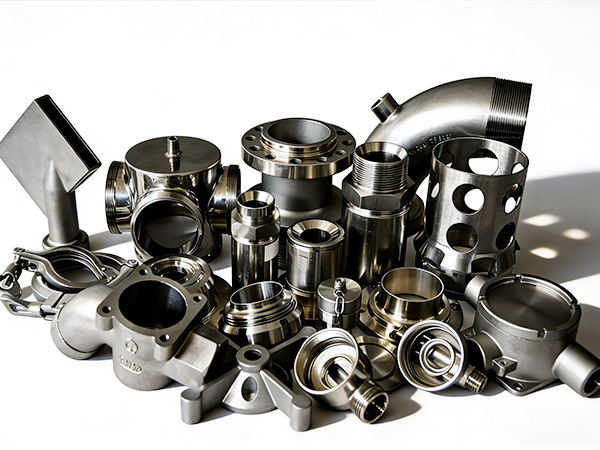
Lost wax casting—formally known as investment casting—has evolved far beyond its ancient origins. This manufacturing technique now produces critical components for contemporary industries requiring complex geometries and superior surface finishes. From ocean-faring vessels to precision pumps, from valve assemblies to custom OEM parts, investment casting delivers solutions that other manufacturing methods cannot match.
.jpg)
Marine Hardware Applications
Marine environments challenge every component with saltwater corrosion, dynamic loads, and biofouling concerns. Investment casting produces hardware that survives decades of harsh oceanic exposure while maintaining structural integrity. The method's ability to create complex shapes without joints or welds eliminates potential failure points.
Shipboard fittings include deck cleats, fairleads, chocks, and grab rails—all benefiting from investment casting's smooth surfaces and consistent wall sections. These components resist corrosion fatigue through homogeneous microstructures that casting produces. No weld Heat Affected Zones compromise corrosion resistance.
Propeller hardware and underwater fittings demonstrate investment casting's value for marine applications. Propeller hubs, shaft brackets, and sea strainers require precise internal passages for fluid passage. The lost wax process creates these complex geometries as single-piece castings rather than assemblies that might leak or fail.
Offshore platforms and subsea equipment push marine applications to extreme depths. Pressure housings and connector fittings must withstand enormous pressures while resisting hydrogen sulfide attack. Duplex and super-duplex stainless steels cast using lost wax methods serve these demanding applications reliably.
Pump Component Manufacturing
Pump manufacturers rely on investment casting for impellers, volutes, and other fluid-handling components. The method's dimensional accuracy ensures proper clearances between rotating and stationary parts. Surface finish quality minimizes turbulence and efficiency losses within the pump casing.
Impeller geometry significantly affects pump performance. Investment casting captures the complex curved passages that engineers design for optimal hydraulic efficiency. The process maintains these carefully calculated geometries without the distortions that other manufacturing methods introduce.
Material selection for pump components reflects the pumped fluid's properties. Corrosive chemicals require alloy compositions that resist attack—often nickel-base alloys or special stainless steels. Investment casting accommodates these difficult-to-machine materials while achieving the precise dimensions that efficient operation requires.
Seal chambers and bearing housings represent additional pump applications benefiting from investment casting. These components require precise dimensions for proper seal and bearing fit-up. The consistency that investment casting provides reduces the variability that causes premature seal and bearing failures.
Valve Body Production
Valve bodies demand complex internal passageways that connect various ports while maintaining smooth flow paths. Investment casting excels at creating these intricate internal geometries. The technique produces valve bodies with minimal post-casting machining requirements.
Control valve bodies require precisely positioned passages for actuator mounting and流体 control. Investment casting maintains the positional accuracy that proper valve function demands. The smooth as-cast surfaces minimize turbulence that might affect control valve response.
High-pressure valve applications push materials and manufacturing methods to their limits. Valve bodies for oil and gas transmission operate at pressures exceeding 10,000 psi. Investment casting produces these components with the density and structural integrity that such demanding applications require.
Specialty valves for chemical service benefit from investment casting's material flexibility. Corrosive chemicals require exotic alloys that machining would consume excessively. The near-net-shape characteristics of investment casting minimize expensive material removal while achieving complex geometries.
Custom OEM Parts Manufacturing
Original equipment manufacturers increasingly specify investment casting for custom components. The method's design flexibility enables optimization that would prove impossible with other techniques. Engineers create components that integrate multiple functions, reducing assembly requirements and potential failure points.
Medical device manufacturers employ investment casting for surgical instruments and implant components. The technique produces intricate geometries with surfaces smooth enough for biological compatibility. Material options include surgical-grade stainless steels, titanium alloys, and cobalt-chromium compositions.
Aerospace applications utilize investment casting for turbine components, structural fittings, and fluid system hardware. Weight reduction drives these applications—the method produces complex shapes that minimize material while maintaining strength. The consistency of investment castings supports aerospace quality requirements.
Textile machinery and printing equipment also incorporate investment-cast components for their precision and durability. The ability to produce small components with excellent surface finishes reduces finishing labor costs across high-volume production runs.
Advantages Across Industries
Investment casting delivers advantages that explain its widespread adoption. The near-net-shape characteristic minimizes material waste—a significant factor with expensive alloys. Complex geometries that would require multiple machining operations become single casting operations. Surface finish quality often meets final specifications directly from the mold, shortening production cycles and reducing labor costs.
Dimensional accuracy reduces the need for expensive precision machining. Critical features frequently require no machining whatsoever. Material flexibility also allows designers to select optimal alloys without manufacturing constraints, expanding the performance envelope available to engineers working across multiple sectors.
Future Directions
Investment casting continues evolving through process improvements and automation. Ceramic shell manufacturing now employs robotic spraying and controlled drying cycles. Pattern production uses injection molding that produces more consistent patterns faster than traditional methods.
Additive manufacturing creates ceramic shells directly from digital models, eliminating pattern production entirely for small batches and reducing lead times significantly.
Process simulation software predicts casting quality before production begins, optimizing gating systems and predicting shrinkage. Manufacturers achieve higher first-pass yields while reducing testing and rework costs.
References
Beeley, P. (2001). Foundry Technology. Butterworth-Heinemann.
ASM International. (1990). Castings: Vol. 15. ASM Handbook Series. ASM International.
Campbell, J. (2015). Complete Casting Handbook: Metal Casting Processes, Metallurgy, Techniques and Design. Butterworth-Heinemann.
Giammichele, L. A. (2013). Investment Casting: Design, Materials, and Process Development. ASM International.
 Recommended Products
.jpg)
.jpg)
.jpg)
.jpg)
.jpg) Contact us
Contact us
—— Contact:Mr. Meng
—— Tel:+86 18233783692
—— Email:mengfy001@gmail.com
—— Url:https://www.kiyama-pipefitting.com
—— Address:Cangzhou Economic and Technological Development Zone, Cangzhou City, Hebei Province, China