

NewsDetails
OEM Metal Parts: Custom Manufacturing Solutions for Industrial Applications
author:Kiyama time:2026-05-26 18:57:13 Click:71
Understanding OEM Manufacturing in Modern Industry
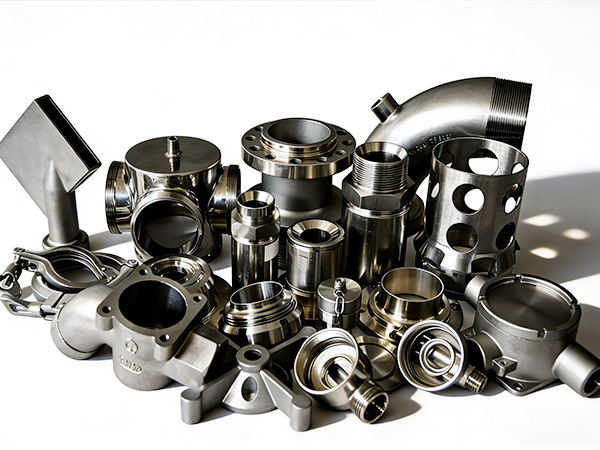
Original Equipment Manufacturer (OEM) relationships have become foundational to how modern industry operates. Rather than every company maintaining complete in-house manufacturing capabilities, businesses increasingly rely on specialized partners who focus on specific processes, materials, or component types. It's an arrangement that allows each party to concentrate on their core competencies while maintaining access to broader capabilities through trusted partnerships.
.jpg)
.jpg)
The dynamic works because specialized manufacturers achieve economies of scale and technical depth that individual companies would struggle to justify independently. A precision casting facility that serves multiple industries can invest in advanced equipment, maintain specialized expertise, and optimize processes in ways that benefit all their clients. For the OEM customer, this translates to better quality, more consistent delivery, and often lower costs than attempting similar production in-house.
At Kiyama Precision Manufacturing, we've built our entire business model around being that trusted manufacturing partner. Since 1993, we've invested in precision casting lines, CNC machining factories, and comprehensive testing capabilities specifically to serve OEM customers who need reliable, high-quality metal components. Our sino-japanese joint venture structure has enabled technology transfer and quality systems that meet international expectations.
Material Expertise in Stainless Steel Manufacturing
Stainless steel isn't just one material—it's a family of alloys, each engineered for specific performance characteristics. When you're supplying OEM parts that must perform in demanding environments, understanding these differences becomes critical. The wrong alloy choice doesn't just affect performance; it can lead to premature failure, corrosion problems, or regulatory non-compliance.
Austenitic grades like 304 and 316 dominate many OEM applications because they offer excellent corrosion resistance, good formability, and weldability. But even within these grades, subtle chemistry differences affect performance. Low carbon versions (304L, 316L) reduce carbide precipitation risks during welding. Molybdenum-containing grades (316, 316L) improve pitting resistance in chloride environments. Making the right selection requires both metallurgical knowledge and application experience.
Beyond austenitic grades, duplex stainless steels, martensitic grades, and precipitation-hardening alloys each serve specific OEM niches. Duplex grades offer higher strength and better stress corrosion cracking resistance. Martensitic grades provide hardness and wear resistance for cutlery and surgical instruments. Understanding when to specify these alternatives—and having the manufacturing capability to process them properly—distinguishes full-service OEM suppliers from limited-capability shops.
Precision Casting for Complex OEM Geometries
Investment casting (lost wax casting) enables OEM part geometries that would be impossible or prohibitively expensive to achieve through machining alone. Complex internal passages, undercuts, thin walls, and intricate external features become feasible with precision casting. The process does require careful design consideration—draft angles, fillets, and uniform wall thicknesses improve castability—but the design freedom remains impressive.
For OEM applications, the as-cast surface finish and dimensional accuracy of investment casting often eliminate or reduce secondary machining requirements. This reduces both cost and lead time. Parts that would require multiple setups and specialized tooling to machine from bar stock can sometimes be cast to near-net shape, requiring only minimal machining at critical interfaces.
Kiyama operates three precision casting production lines, giving us substantial capacity for OEM production runs. Our experience with stainless steels, coupled with Japanese quality management practices, ensures that cast parts meet dimensional specifications and material property requirements consistently. Whether you need hundreds of pieces or thousands, our process control systems maintain the consistency OEM customers depend on.
CNC Machining Capabilities for OEM Components
While precision casting handles complex geometries admirably, many OEM applications require the tight tolerances and superior surface finishes that CNC machining provides. Threaded connections, sealing surfaces, bearing fits, and other precision features often demand machined surfaces. Having both casting and machining capabilities in-house positions Kiyama to supply finished OEM components without requiring coordination between separate suppliers.
Modern CNC equipment has transformed what's possible in OEM parts production. Multi-axis machines can complete complex parts in single setups, reducing handling time and eliminating setup-induced variation. Live tooling in CNC lathes enables milled features without secondary operations. And automated part loading systems allow lights-out production for suitable workpieces, improving cost competitiveness for higher-volume OEM runs.
Programming expertise matters enormously in CNC machining. The difference between a program that produces acceptable parts and one that optimizes cycle time, tool life, and surface finish can be substantial. Experienced CNC programmers understand how different stainless steel grades behave during cutting, allowing them to select appropriate speeds, feeds, and tooling strategies. This knowledge translates directly to part quality and manufacturing economics.
Quality Assurance Systems for OEM Supply
OEM relationships succeed or fail based on consistent quality and reliable delivery. A single batch of defective parts can disrupt assembly lines, damage customer relationships, and create expensive rework. That's why quality assurance systems form the foundation of successful OEM supply partnerships.
Comprehensive quality management begins with incoming material verification. Chemical composition analysis via spectrometer ensures that alloy certifications match actual material chemistry. Mechanical property testing validates that heat treatment produces target strength and ductility. Only after materials pass incoming inspection do they enter production.
In-process quality control monitors critical parameters during manufacturing. Statistical process control tracks dimensional trends, enabling adjustment before out-of-tolerance conditions develop. First-article inspection verifies setup accuracy. In-process gauge checks confirm critical dimensions at appropriate intervals. These activities, while adding some production time, prevent much larger costs associated with defective part discovery at final inspection or, worse, at customer facilities.
Final inspection and testing provide the last quality gate before parts ship to OEM customers. Coordinate measuring machines verify complex geometries. Pressure testing confirms leak-free performance for fluid handling components. Surface finish measurement ensures that aesthetic and functional surface requirements are met. Documentation packages accompanying shipments provide traceability and test verification that support customer quality systems.
Communication and Project Management for OEM Success
Technical communication represents an often-overlooked but critical aspect of OEM supply relationships. Drawings must be interpreted correctly. Material specifications must be understood and met. Testing requirements must be fulfilled completely. When suppliers and customers speak different technical languages or operate under different standards, misunderstandings can create expensive problems.
Kiyama's experience supplying international markets has taught us the importance of clear technical communication. Our engineering team reviews drawings and specifications carefully, asking clarifying questions before production begins. We provide sample parts for customer approval when requested. And we maintain documentation in formats that support customer traceability and quality system requirements.
Project management becomes increasingly important as OEM part complexity and production volumes increase. Coordinating material procurement, pattern production, casting, machining, finishing, and shipping requires systematic planning. Proactive communication about lead times, potential delays, and delivery schedules helps OEM customers plan their own production effectively. This reliability builds trust that sustains long-term supply relationships.
Conclusion: Building Successful OEM Partnerships
OEM manufacturing relationships work best when both parties view the arrangement as partnership rather than simple transactional purchasing. Sharing forecasts, discussing design changes early, collaborating on cost reduction initiatives, and working through quality or delivery challenges cooperatively—these behaviors build resilient supply chains that withstand market fluctuations and competitive pressures.
Kiyama Precision Manufacturing brings decades of experience, comprehensive manufacturing capabilities, and a commitment to customer success as an OEM partner. Whether you need precision cast components, CNC machined parts, or finished assemblies incorporating multiple manufacturing processes, we're equipped to support your requirements with quality, reliability, and technical expertise that justifies your trust.
References
Manufacturing Today - "Building Successful OEM Supply Relationships" (2023)
Industrial Supply Magazine - "Quality Assurance in OEM Parts Production" (2022)
Precision Casting Journal - "Investment Casting for OEM Applications" (2023)
Stainless Steel World - "Material Selection for OEM Metal Components" (2023)
 Recommended Products
.jpg)
.jpg)
.jpg)
.jpg)
.jpg) Contact us
Contact us
—— Contact:Mr. Meng
—— Tel:+86 18233783692
—— Email:mengfy001@gmail.com
—— Url:https://www.kiyama-pipefitting.com
—— Address:Cangzhou Economic and Technological Development Zone, Cangzhou City, Hebei Province, China